Here’s how to find your draw length: measure your wingspan fingertip to fingertip and divide by 2.5.
A 70-inch wingspan is a 28-inch draw. A 75-inch wingspan is a 30-inch draw. Use the chart below, then confirm the number with a wall measurement or a shop draw-check arrow before you buy a bow.
Draw length decides whether a compound bow fits, whether a recurve feels stacked, and whether your arrows are long enough to be safe. Get it wrong by an inch and groups open up, the pin floats, and shoulders start complaining.
What draw length actually means
Draw length is not “how far I can pull.” It is a standardized measurement.
Under the AMO standard still used across the industry (now maintained by the Archery Trade Association), draw length is the distance from the nocking point on the string to the pivot point of the grip, plus 1.75 inches, at full draw.
That 1.75-inch add-on is why two people can talk past each other. The raw nock-to-grip number is true draw. The number printed on a bow box is AMO draw length. Manufacturers use the AMO number.
Example: 26.25 inches from nock to pivot + 1.75 inches = 28 inches AMO. That 28-inch figure is also the industry reference for marked draw weight.

Why the number has to be right
A draw that is too short collapses the bow shoulder, pulls the drawing elbow out of line, makes the pin jump, and leaves unused power in a compound cam.
A draw that is too long forces a lean-back posture, puts extra string on the face, locks the bow elbow, and can cause string slap and shoulder strain.
Half an inch is enough to change groups. An inch is enough to make a good bow feel like a bad one.
Draw length chart (wingspan ÷ 2.5)
Use this chart when you need a quick way to find your draw length from wingspan. Measure from the tip of one middle finger to the other, arms level, shoulders relaxed, palms forward. Do not stretch.
Starting draw length = wingspan (inches) ÷ 2.5
Round to the nearest quarter-inch for a compound module, or the nearest half-inch if you are shopping a fixed-draw cam.
| Wingspan | Starting draw length | Typical height (rough only) | Suggested arrow length |
|---|---|---|---|
| 57 in | 23.0 in | about 4’9″ | 24–25 in |
| 60 in | 24.0 in | about 5’0″ | 25–26 in |
| 63 in | 25.0–25.5 in | about 5’3″ | 26.5–27.5 in |
| 65 in | 26.0 in | about 5’5″ | 27–28 in |
| 67.5 in | 27.0 in | about 5’7″ | 28–29 in |
| 70 in | 28.0 in | about 5’10” | 29–30 in |
| 72.5 in | 29.0 in | about 6’0″ | 30–31 in |
| 75 in | 30.0 in | about 6’3″ | 31–32 in |
| 77.5 in | 31.0 in | about 6’5″ | 32–33 in |
| 80 in | 32.0 in | about 6’8″ | 33–34 in |
Arrow length is not draw length. Cut arrows 1 to 2 inches longer than AMO draw so the point sits safely past the rest.
Height is only a sanity check. Two people who are both 5’11” can be a full inch apart in draw because arm length and shoulder width differ. Measure wingspan. Do not buy off height.
Some coaches use an alternate formula: (wingspan − 15) ÷ 2. On a 70-inch span that gives 27.5 inches instead of 28. If the two formulas disagree, start in the middle and confirm on a bow.
Method 1: Wingspan (fastest, works at home)
This is the method shops use when they need a starting number in 30 seconds.
- Stand with your back against a wall. Feet under the hips. Do not puff the chest.
- Raise both arms to shoulder height so your body makes a T. Palms face forward. Elbows straight but not locked. Shoulders low.
- Have a helper measure from the tip of one middle finger to the tip of the other. Keep the tape taut across the back, not draped.
- Divide by 2.5.
This is the fastest way to find your draw length at home. Example: 71 inches ÷ 2.5 = 28.4 inches. Ask the shop for 28.5 inches and test 28.0 and 28.5.
If you are alone, mark both sides of a doorway at your fingertips, then measure the marks.
Errors that inflate the number: reaching or shrugging, measuring to the fingernail, a bent elbow, or using height instead of wingspan.
Errors that shrink it: soft elbows, hunched shoulders, or measuring across the chest instead of fingertip to fingertip.
Wingspan is usually inside a half-inch for most adults. It can miss if you have very long or very short fingers, unusual shoulder width, or an established anchor that is higher or lower than average. Confirm it with one of the methods below.
Method 2: Wall method
The wall method is another way to find your draw length if wingspan feels off. It ignores finger length and ties the number to a real anchor.
- Stand sideways to a wall on your bow-arm side.
- Keep shoulders low and relaxed. Raise the bow arm to shoulder height and make a fist, as if you were holding a grip.
- Step in until the knuckles of that fist just touch the wall. Do not lean.
- Keep the head upright. Turn only the head toward the wall, the way you would look at a target.
- Have a helper measure from the wall to the corner of your mouth.
That reading is a close stand-in for the draw you will actually shoot. Many archers find it matches their finished compound setting better than wingspan alone, especially if they have long fingers.
Method 3: Marked arrow or draw-check bow (most accurate)
This is the number that should win if the first two disagree.
- Use a low-poundage bow or a shop draw-check bow.
- Nock a measuring arrow marked in quarter-inch increments, or slide a business card onto a long uncut shaft.
- Draw to your real anchor: head up, shoulders level, bow arm soft, drawing elbow in line with the arrow.
- Have someone read the mark at the pivot point of the grip (the throat).
- Add 1.75 inches. That is AMO draw length.
If the measuring arrow is already printed to AMO / ATA, do not add 1.75 again. Read the instructions on the shaft.
Repeat the draw three times. If the readings jump more than a quarter-inch, form is still moving. Do not cut arrows or order cams until the number settles.
Recurve and traditional shooters use the same AMO definition. You do not have a module to swap, so the measurement still matters for bow length, arrow length, and spine. A longbow or recurve that is too short for your draw will stack hard at the end of the pull.
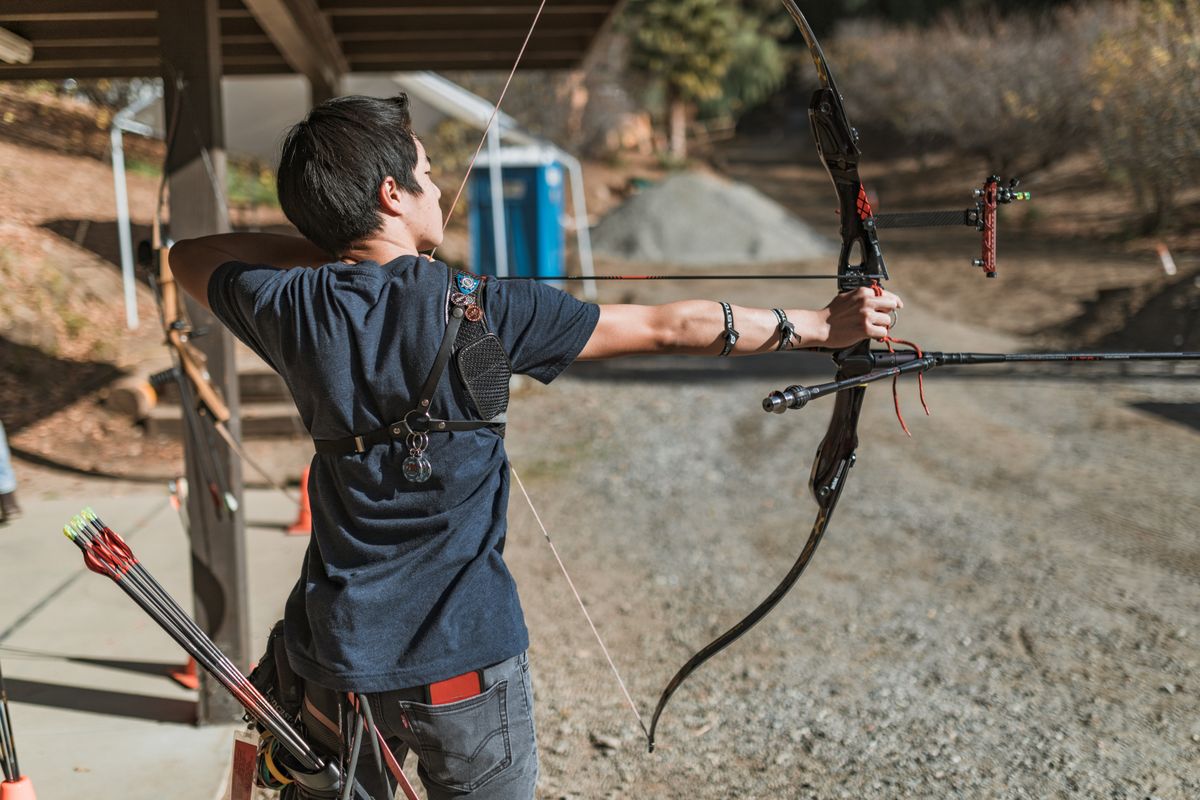
How to tell if the number is right on a real bow
Good fit
- Shoulders sit level, not rolled forward
- Bow arm is almost straight, with a soft elbow — not locked
- Drawing forearm lines up with the arrow
- String touches the tip of the nose and the corner of the mouth without plastering the face
- You can hold at full draw without leaning back
Too short
- Drawing elbow sticks out to the side
- Front shoulder hunches into the neck
- You feel cramped, as if you ran out of bow before you ran out of arm
Too long
- You lean back to reach the wall
- Heavy string contact across the face
- Bow elbow locks or the shoulder shrugs to finish the draw
- The pin floats in a big, slow circle
Most modern hunting bows adjust in half-inch or quarter-inch steps. Stay inside the bow’s published range. A 27–30.5-inch bow will not become a 32-inch bow.
Compound vs. recurve vs. youth
Compound: Set the cam to your measured AMO length, then micro-adjust after a few dozen arrows. A wrist strap vs. a handheld release often needs a D-loop or strap tweak rather than a full inch of cam change.
Recurve / longbow: There is no module wall. Your draw is wherever you anchor. The wingspan number is still the right starting point for bow length and arrow length. As a rough traditional guide:
- Under 26-inch draw → 64–66 inch longbow
- 26–27 → 66–68
- 28–29 → 68–70
- 30+ → 70–72
When you are between sizes, go longer. A slightly long traditional bow is smooth. A slightly short one stacks.
Youth: Re-measure every season. A growing shooter can pick up a half-inch of draw in a year. Buy adjustable compounds and leave extra arrow shaft until growth slows.
Arrow length, spine, and draw weight
Once draw length is set:
- Order or cut arrows 1–2 inches longer than AMO draw. See our guide to choosing compound bow arrows.
- Use that arrow length, plus your actual draw weight at your draw, to pick spine. A 28-inch arrow at 60 pounds is not the same spine as a 30-inch arrow at 60 pounds.
- Recurve and traditional draw weight is marked at 28 inches AMO. A 30-inch shooter pulls more than the limb stamp. A 26-inch shooter pulls less. Plan on about 1.5–2.5 pounds per inch on many conventional limbs.
That is why shops ask for draw length before they talk speed or brand.
FAQ
Can I measure draw length by myself?
Yes. You can find your draw length by yourself with a wall and a tape measure. Wingspan against a wall works solo if you mark both sides. The wall method and a marked arrow are more accurate with a helper.
Is wingspan divided by 2.5 official?
It is the industry’s standard estimate, not the legal definition. The official definition is nock-to-pivot plus 1.75 inches. Use ÷ 2.5 to get in the door, then confirm.
What is the average adult draw length?
Most adult men land near 28–29 inches. Most adult women land near 26–28. Plenty of good shooters sit outside those bands.
Does a peep or a kisser button change draw length?
They change where you want to land, which can change the cam you choose by a quarter-inch. Measure form first, then install the peep so it hits your eye at that draw.
Should I size up “just in case”?
No. Extra draw length is not extra speed you can use. It is extra strain. If you are between sizes, test both.
What to do next
- Once you find your draw length, write it down and use it to set the bow and cut arrows. Then pick a bow that covers that measurement in our best compound bows for beginners guide.
- Cross-check with the wall method.
- Confirm on a draw-check bow at a shop.
- Write down your AMO draw length, the date, and the method used.
- Use that number for the bow, then for arrow length and spine.
If you already own a bow and groups suddenly opened up, re-measure. Form changes. So does the right draw.
