The Best Compound Bows

Complete Comparisons and Reviews

Review: The Best Compound Bow Sights for 2018

by thehoth

bow sights

Bow-hunting is unlike any other form hunting. It puts you in tune with your body, and the animals you’re going after. Its incredible difficulty also makes it that much more rewarding once you’ve actually recorded a kill.

Hunting with a bow goes back thousands of years, and doing it now puts you in touch with the more primordial side of our ancestry. It’s a refreshing change from the modern lives we all live.

However, just because bowhunting is as old as civilization itself, doesn’t mean that your tech has to be. Bowhunting has undergone tremendous innovation over the years. This is especially true when it comes to bow sights.

If you want to improve your bowhunting performance, check out this list of the best bow sights available in 2018.

But if you’re completely new to bowhunting, perhaps you’ve jumped the gun. Check out our introduction to compound bow shooting first before you start perusing this list.

IQ Define

This bow sight is truly one of a kind. It’s a five-pin sight paired with a built-in rangefinder with a guaranteed accuracy of plus/minus one yard.

With the IQ Define, you no longer have to reach into your pocket or backpack to find your independent rangefinder and risk scaring off your prey.

This sight is light and ergonomically designed to preserve the balance of your bow.

Trophy Ridge React 5-Pin

What makes this bow sight stand out among the rest on the market is its lightness and versatility.

It is made of copolymer materials, making it 25% lighter than primarily aluminum-made sights on the market. Because of this, it is also rust and corrosion-proof. Its lightness also allows it to keep the balance of the bow intact and reduces the vibration of the bow when you shoot.

The sight has several different mounting holes so that you can place it exactly where you want it on your bow. Its bracket is also reversible, meaning it can be used for a lefty or righty.

Garmin Xero A1i

Garmin is most famous for manufacturing GPS systems, so you already know you can trust that this bow sight will have the best range-finding capabilities on the market.

This sight auto-ranges and projects a lighted pin for the exact distance it measured. The A1i also estimated the arrow’s point of impact and sends the information it records to a Garmin-compatible device. If you’re a stats junkie this is definitely one of the best bow sights on the market for you.

AXCEL Sights RheoTech

The AXCEL RheoTech is a powerhouse when it comes to customizability. This sight offers four-, five-, and seven-pin options. Choose whatever you wish.

This sight also allows you to adjust the brightness of the pins by simply turning the sight’s RheoStat Cover.

This AXCEL sight also boasts a diamond-shaped mounting bar which will aid in its sturdiness and durability.

TRUGLO Archers Choice Range Rover Pro Green Dot Sight

This sight sticks out among the crowd because instead of pins, this sight uses a green LED dot for aiming. And with a 700-hour battery, you don’t have to worry about that green dot ever disappearing.

TRUGLO sight owners also benefit from being able to use their Zero-In Adjustment Dial, which delivers stunning accuracy and allows you to easily dial your shot for windage and elevation.

This sight also has 40 yards of pre-marked yardage so short range-finding is made simple.

CBE TL-3

This innovative sight boasts some innovative tech called the ArmedGuard Fiber Management System. The pins on this bow are powered with fiber optic cable. This makes them so bright that you can see them clearly in the pitch-black dark of night or the gray, obstructive fog of early morning.

This bow also sports several mounting holes and has stainless steel bolts so rust should be a thing of the past.

HHA OL-5519 Optimizer Lite

This movable-pin sight might be the best in its class. It’s good for both lefties and righties, is rust- and corrosion-resistant, and has pins powered by fiber optic cable.

It also sports a rheostat light that allows you to adjust the brightness of your pins. The only downside of this sight is that since it is single-pin, making measurement adjustments on the fly may take longer than other sights on the market.

Trophy Ridge 1 Pin .010 RH React-One Sight

This is the second Trophy Ridge bow sight on this list and it’s for good reason. They make good bow sights, and this is the single best single-pin sight on the market.

This sight boasts Smart Pin Technology, so the sight can calculate the pin gap up to 100 yards on its own. It also has second and third-axis adjustments so you can really key in on your prey from any height or distance.

It’s also made of 100% aluminum, which while heavy, makes this sight extremely durable.

Hoyt PRO XCEED

This is another single-pin sight. It’s not as intricate as the aforementioned Trophy Ridge single-pin, but its simplicity is the appeal here.

Single-pins allow you to dial in exact distances and this has never been simpler on the Pro XCEED.

Also, if you like to put a little flair on your bow, this sight has interchangeable sight rings of different colors.

Spot Hogg Double Pin — Double Pointer

This sight boasts an aiming system know as the Double Pin – Double Pointer. This system involves two pins and allows you to calculate the distance of both pins no matter where the dial is set.

The benefits of this are huge, and should drastically cut down your time calculating your shot. With this simple system and an uncluttered sight-window (who needs all those pins anyway), this sight is a breeze to use.

Now That You’ve Seen The Best Bow Sights…

If you don’t want to skimp on getting a bow sight, you shouldn’t skimp on getting an actual bow either.

Check out our review of the top 3 best compound bows on the market and see if any of them are to your liking.
Filed Under: Compound Bow

How to Tune Crossbow Arrows

by thehoth

crossbow arrows

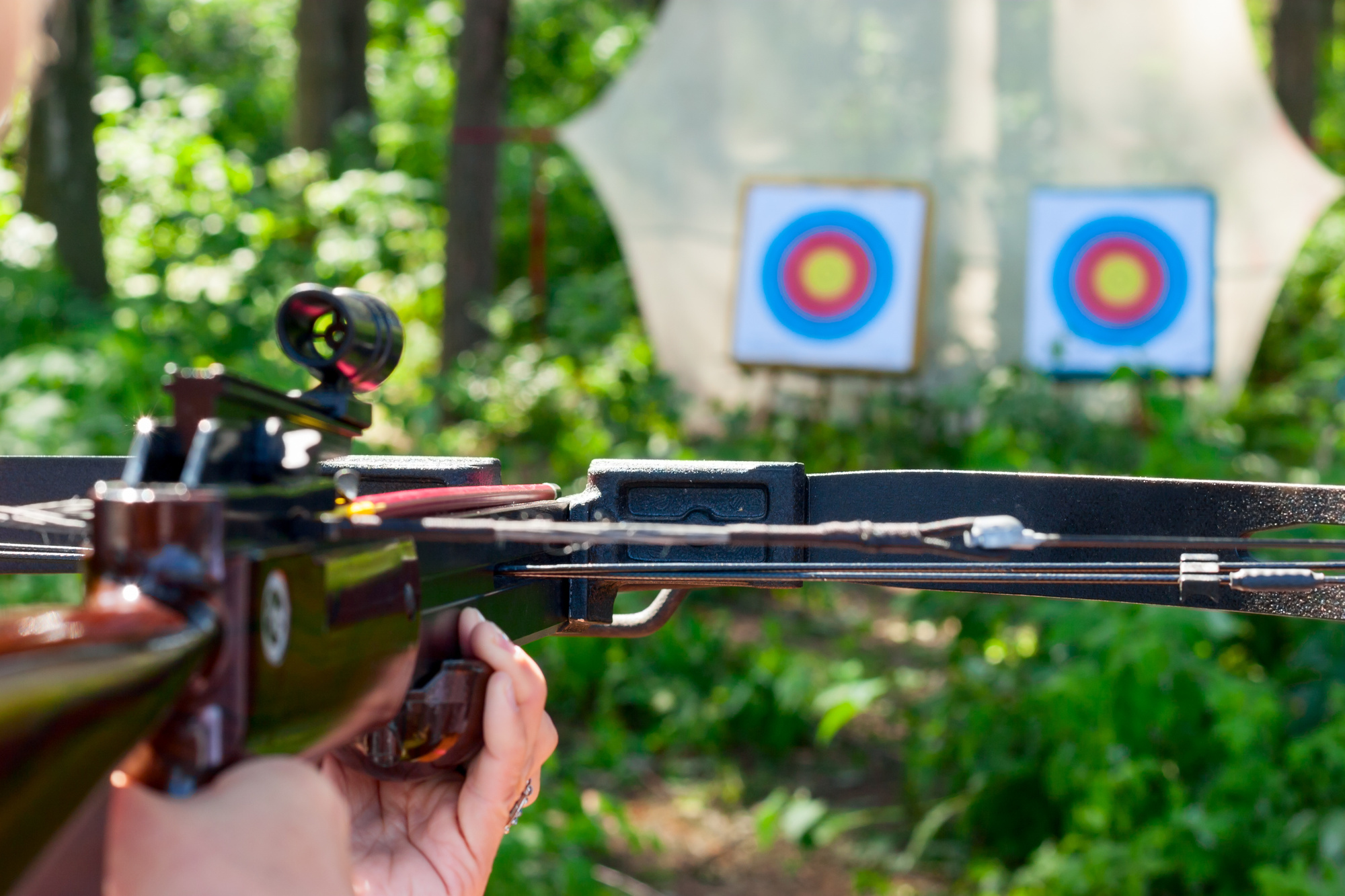
Did you notice on your last hunting trip that your buddy didn’t pull his crossbow arrows out of a pack? Then, after asking him about it you realized he actually fletched his own?

Tuning your own arrows is a great way to improve your accuracy that goes beyond the time you spend shooting into the hay bale (although that doesn’t hurt). Keep reading to find out why fletching your own arrows will help and what you need to know to do it well.

If you’re just starting out, don’t think tackling something like this is outside the scope of your expertise. Even if you’re just getting started, this is a straightforward process that can be useful for any archer at any level.

This practice may even turn into a new hobby!

Why You Should Spend the Time

The simple reason to invest in this “upgrade” to your crossbow arrows is the improved accuracy you’ll gain. Beyond that, you’ll be more in tune with your gear than you were before you started.

Speaking of tuning, you’re probably already tuning your bow. Or if it’s brand new, you know that you will need to be aware of the tuning down the road.

Basically, proper maintenance of your crossbow is already on your radar. Now it’s time to invest some of that care into your crossbow arrows as well.

Fletching your own bolt ensures your arrow will fly straight to its target every time. Packaged arrows are fine, but they have the potential for getting damaged during shipping.

You also want to shoot in practice what you’re going to use when shooting at the real thing. Take the time to fletch your arrows, practice with them, and fine-tune the process that works best for you. All these things will pay off when it’s time to lift the sights for real.

How Do You Fletch Crossbow Arrows?

Before we jump into the arrows themselves, it’s appropriate to step back and make sure the technique you use with your bow is correct.

Taking a quick look at that may seem overly simplistic. But if your technique is off, you will only be more and more frustrated as you try to fine tune arrows with poor results. In other words, fletching your own arrows won’t fix your technique as an archer!

First, we will address the components you need to start tuning your arrows.

The Bolt

You want the bolt to be as straight as possible. That may sound like a no-brainer, but there are different quality bolts available. Spend a little more for a better quality bolt.

Make sure the bolt you buy has nocks on it that are compatible with your bow. There’s not much worse than going through this whole exercise and realizing the bolt you bought won’t work.

The Broadhead

You may already have a style you like. That’s fine, you can stick with what you like. Keep in mind how much the broadhead weighs as it compares to the rest of the bolt and vanes.

You don’t want to add too much weight to your bolt, it will shed too much speed and be ineffective. But on the flipside, you don’t want to lose so much weight in the pursuit of speed that it dips under the optimum weight prescribed by your bow.

The manufacturer of your bow knows best. Follow their lead and land as close to the weight recommendation as possible.

The Feathers or Vanes

Here too, you need to know what’s recommended for your bow. If you already have the bolt and you followed the instructions above, you bought ones with the correct nocks on it.

The key to buying vanes is simple: Buy ones that fit the nock pattern for your bolt and rig. From there, you can start to have some fun.

Some Assembly Required

This may sound intimidating, but it’s really not that bad. You have all the pieces and it’s pretty obvious where they all go.

When gluing the vanes onto your bolt, the best tip we can offer is to get a slow-drying glue. Don’t worry about making a mess, you’re not the first. But slower drying glue gives a little leeway before everything becomes solid.

The real fun with assembly is you now get to experiment with the type of rotation you want to achieve. There are three main styles:

  • Straight – the vane sits straight on the bolt
  • Offset – the vane sits straight, but with a slight twist from the back to the front of the fletching.
  • Helical – the vanes are fletched with a slight curve.

Of those three, the helical fletch tends to get the best results. But this begins to move into the realm of personal preference pretty quickly. There’s some science to how the arrows fly, yes. But at the end of the day, your comfort is key.

One way to test your work is with an arrow spinner. They will help you test the wobble in your crossbow arrows to make sure you have put together something that will fly straight and true. They are very simple to make at home.

Own It

If you’ve ever spent any time around a competition pistol or rifle shooter, it won’t be long until you hear about the weight they prefer for their trigger. Each of them swears by what they have become accustomed to.

Some like a long pull that’s smooth and heavy. Others prefer the trigger to be right next to the guard so that the smallest touch fires a round.

Both of them are entitled to their own opinions.

The same is true with fletching. You may hear people who are strong proponents of certain fletching styles and mock those that don’t conform to their ideal.

Find the fletch that suits you and your bow the best and stand behind it. Enjoy the process and be creative as you experiment with different vanes and styles.

In short, enjoy your new hobby! Contact us anytime for the best in crossbow arrows and bows. We’d love to hear your story!

Filed Under: Compound Bow

A Guide to Compound Bow Sights

by thehoth

compound bow sightsHunting without compound bow sights is like riding a bike without using your hands. Sure, you could probably learn how to do it reliably with enough time, but there’s a much easier way to get to where you want to be.

If you’ve already been introduced to the sport of compound bow shooting, you may feel you’re ready to start assembling your first kit. With everything that goes into a full kit, it’s easy to forget that the devil is in the details.

Ready to determine which bow sight is right for you?

Types of Sights

While every aspect of the bow is important, it is argued that if there is a place to invest a little extra money, your bow sights are the right candidates. To that end, a brief rundown on the more common varieties of sights and their use would be valuable.

The sights on a bow consist of two parts. First, there are the compound bow sights themselves, which get mounted on the riser just above the grip. The bow sight works in conjunction with the peep sight, which served into the bowstring.

The archer looks through the peep sight and lines up its aperture with the bow sight. Seems simple enough, right?

Peep sights are simple. Most are just a basic circle used as a reference point used in conjunction with the bow sights.

In this primer, we’ll be looking more in depth at the bow sights. Specifically, the two most common variants on the market today.

Fixed Versus Adjustable: The Two Basic Compound Bow Sights

Fixed Pin

The fixed pin variant is the most common, with beginner and intermediate level archers.

The simplest of all the designs, the fixed pin variant consists of a ring with between three and seven pins representing different distances from the archer.

The biggest benefit here is ease of use. All the archer needs to do is gauge their approximate distance from the target and use the corresponding pin to find their mark.

Beginners can use a range finder to assist in estimating their distance. After some practice, most archers can learn to gauge their distance from a target with a reasonable degree of accuracy.

Moveable Pin

The second most common variant is the moveable pin sight. Rather than having a stack of pins, each relating to a different yardage, the movable pin sight only has a single pin. The pin of a moveable pin sight is affixed to a slider that allows the archer to adjust the sight on the fly.

Whether or not the moveable pin sight is worth mastering is a point of contention. Some archers swear by the movable pin sight, others say that whatever advantages it might hold are offset by its drawbacks.

Arguments in Favor of the Moveable Sight

Proponents of moveable pin compound bow sights point out that they provide a less cluttered view than that of a fixed pin sight. An archer using a fixed pin sight with five or even seven pins would find that up to 45% of their sight picture may be obstructed.

Even ignoring the sight obstruction, the added clutter can make it easier to make simple mistakes. When using a sight with more than three pins, it’s easy to accidentally use a 50-yard pin when you meant to use the 40-yard pin.

The high speeds that modern bows are able to reach make matters worse. Many launch arrows at speeds in the neighborhood of 350 feet per second. At these speeds, the yardage gaps between the pins on a fixed pin sight are rather small, and differentiating between them is more difficult.

The primary advantage of the movable pin sight over the fixed pin variant is that it allows for a higher degree of accuracy when determining your distance from a target.

If a hunter is sighting a buck at 50 yards, but their fixed pin sight only has pins for 40 and 60 yards, they would be forced to compensate by eyeballing the difference and hope for the best. With the aforementioned high speeds of modern bows, the margin of error allowed to them is slim.

A moveable pin sight remedies this by allowing the archer to make quick and precise adjustments down to the yard. If a hunter determines their quarry to be exactly 57 yards away, all it takes is the twist of a knob or slide of a lever to perfectly sight their target.

Even archers who admit their bias against moveable pin sights admit that virtually every archer is more accurate when they are able to hold their aiming pin dead on target rather than having to make estimates.

Arguments for the Fixed Sight

Criticism of moveable pin sights center on two main aspects: the high degree of precision required when sighting a target, and the amount of time it takes to do so.

The issue of sighting is not unique to single pin sights of course. In order to maximize the benefits of the adjustable sight, you need to be able to sight your target down to the exact yard. As fixed pin sights require an element of estimation as is, in a sense they are somewhat more forgiving to novices.

The bigger issue is the time it takes to adjust a moveable sight, and how this applies to trying to hit a moving target. A hunter cannot count on their quarry to hold still while they line up a perfect shot.

Often the only shot afforded to a hunter presents itself when their quarry is either approaching or moving away from their position. This can prove problematic if the target diverges from its path, comes to a stop, or makes any number of moves that the hunter was not counting on.

In this situation, the hunter would be forced to estimate the difference between where they expected the target to be and where it actually ended up, or make a hasty adjustment to their sight and risk missing their only opportunity for a clean shot.

If you have an outfitter or a more experienced friend helping you select your first bow set-up, they will more then likely recommend you a fixed-pin sight. While difficult to achieve the same level of precision with one, they are generally perceived as being easier to learn with, and therefore better suited to beginners.

No Right or Wrong Answer

Between the two, both have their positives and negatives. And of course, proper form and technique are required to get the most out of either.

What any aspiring archer needs to do it take their time when assembling their first kit. Only by experimenting with both variants on the range will you find the natural fit for you.

Naturally, the sight will only be as effective as the bow it is affixed to. Remember to check our guide to assembling the best bow for your price point before making your purchase.

Filed Under: Compound Bow

  • « Previous Page
  • 1
  • 2
  • Compound vs Traditional Recurve Bow
  • About
  • Contact
  • Privacy Policy

© 2025 The Best Compound Bows